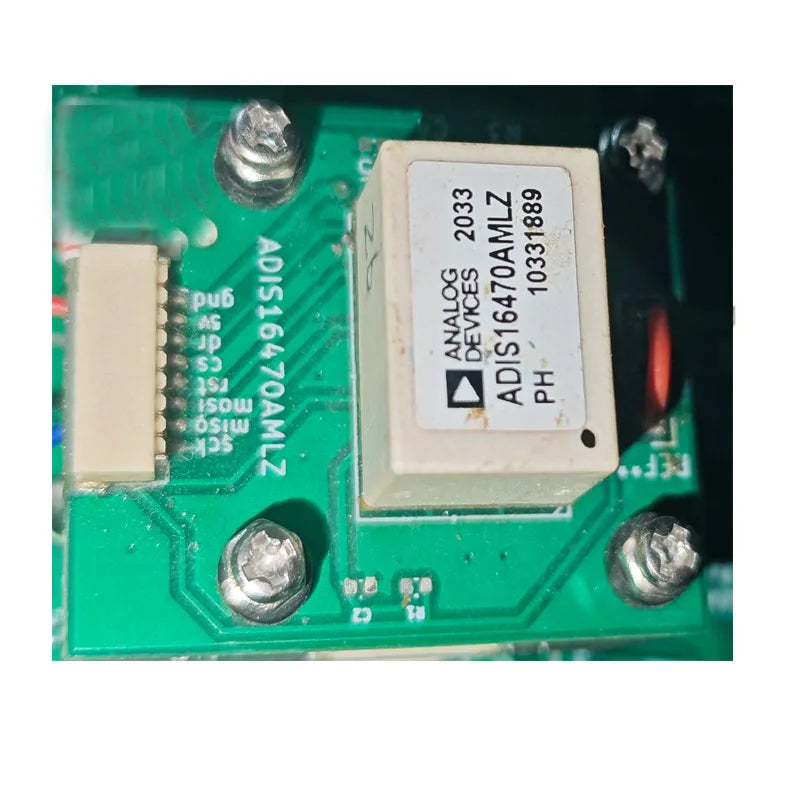
Integrates ADIS16470 high-performance MEMS IMU multi-mode satellite navigation receiver Module KM-06 for Replace ADIS16470/PCB
Integrates ADIS16470 high-performance MEMS IMU multi-mode satellite navigation receiver Module KM-06 for Replace ADIS16470/PCB
Couldn't load pickup availability
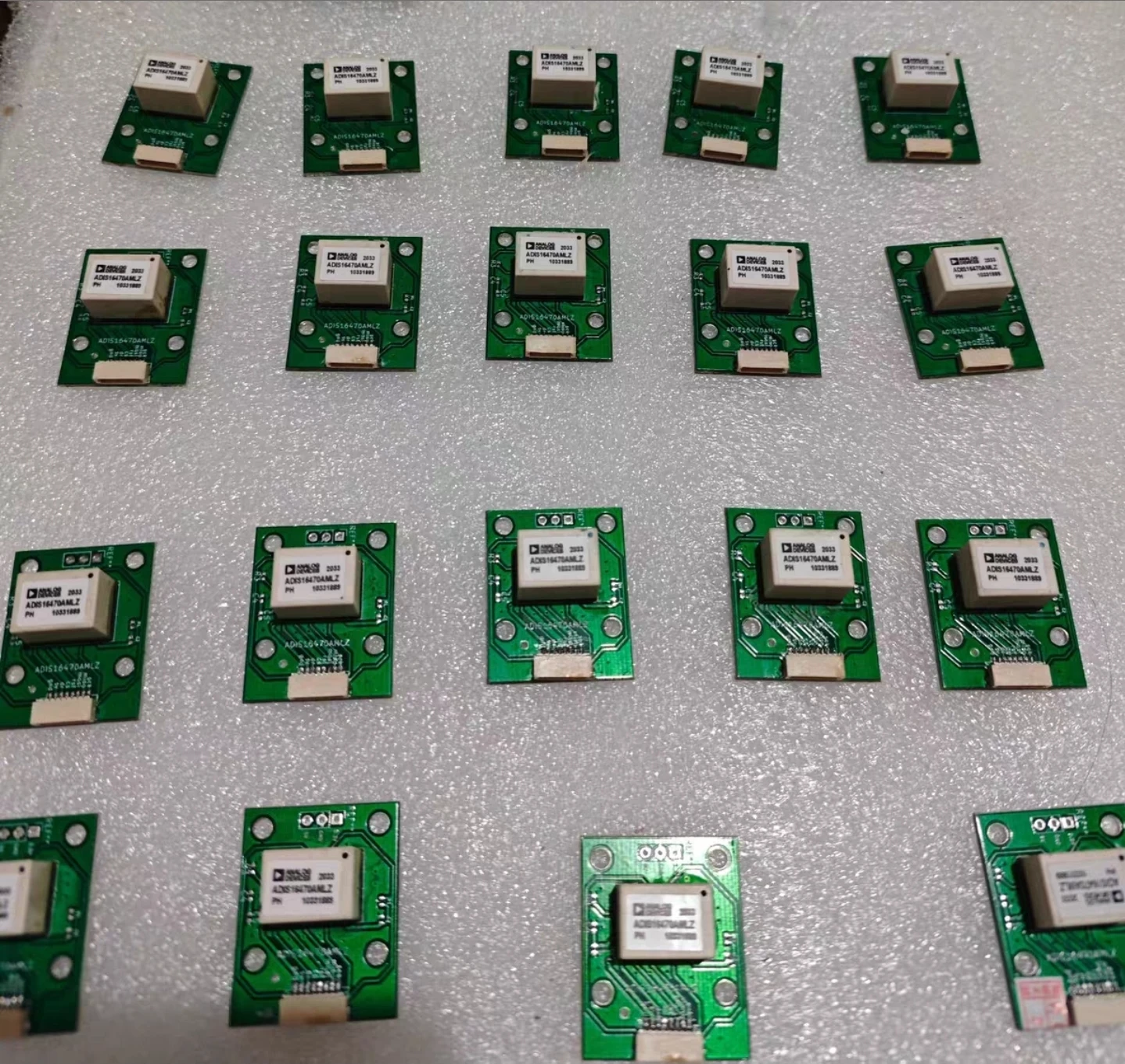
KM-06 is a tactical-level flight control system designed for high-dynamic and high-impact scenarios. Its core integrates the Analog Devices ADIS16470 high-performance MEMS inertial measurement unit (IMU) and a multi-mode satellite navigation receiver to form a highly integrated combined navigation system. With its ±2000°/s gyroscopic range, ±40g accelerometer range, and full-temperature factory calibration, the ADIS16470 can provide stable inertial data in ejection, high-speed flight, and complex electromagnetic environments. The system integrates inertial navigation (INS) and satellite navigation (GNSS) data through a deep-coupled Kalman filter algorithm, supports the activation of the built-in pure inertial navigation mode under extreme conditions such as GNSS loss of lock and magnetic field interference, and continuously outputs high-precision position, velocity, and attitude information. It is suitable for ejection drones, fuel drones, cruise missiles, guided rockets, portable missiles, and other scenarios with strict requirements on dynamic response and reliability.
II. Hardware parameters
(I) IMU indicators (ADIS16470 core features)
1. Dynamic range
◦ Gyroscope: Accurate range of ±2000°/s, supports maximum range expansion under short-term overload, and meets the data collection requirements of aircraft with high-speed roll, pitch, yaw and other strong dynamic movements.
◦ Accelerometer: ±40g full range coverage, 2.5 times higher than traditional industrial-grade IMU, can capture the violent impact acceleration at the moment of guided weapon launch (such as the overload peak when the rocket launches).
2. Accuracy and stability
◦ Gyroscope: Zero bias stability 8°/h at 25°C, angle random walk 0.34°/√h, noise density 0.008°/s/√Hz (10-40Hz frequency band), full temperature range (-25°C~+85°C) through factory calibration to compensate for temperature drift, nonlinear error and inter-axis coupling error, to ensure the accuracy of attitude solution in high-speed motion.
◦ Accelerometer: zero bias stability 13μg, speed random walk 0.037m/s/√h, noise density 100μg/√Hz, supports linear acceleration and vibration interference suppression, and meets the stringent requirements of guided weapon flight trajectory calculation for low-frequency noise.
3. Environmental adaptability
◦ Operating temperature range: -25°C~+85°C, storage temperature -65°C~+150°C, adaptable to high and low temperature alternating environment.
◦ Shock resistance: 2000g (1ms half-sine wave), passed the MIL-STD-810H military standard vibration test, and can withstand strong shock conditions such as catapult launch and air maneuvering.
(II) Pure inertial navigation performance indicators (when GNSS is locked and magnetic field interference occurs)
• Position offset: about 5.18 meters in 30 seconds (theoretical calculation), about 41.33 meters in 1 minute. The error is mainly caused by the accumulation of acceleration projection deviation caused by gyroscope bias and attitude error, which is suitable for tactical applications that are temporarily out of satellite navigation.
• Angle drift: 8° accumulated in 1 hour, due to the long-term bias stability of the gyroscope. The error growth rate can be slowed down through the optimization of the built-in error state Kalman filter.
(III) Auxiliary sensors and interfaces
• Barometer: SPL06 high-precision pressure module, ±0.1mbar measurement accuracy, auxiliary altitude solution.
• Communication interface: 7×UART, 1×I2C, 1×SPI, support for peripheral access such as laser radar and visual sensor; 8×PWM channels (support DShot protocol), response speed ≤10μs, suitable for high-speed electric adjustment and servo.
• Power management: Dual BECs are independently powered (5V/2.5A for flight control, 9V/2.5A for image transmission/camera), support overvoltage/overcurrent protection and low voltage alarm, power supply ripple ≤50mV, ground impedance ≤1Ω.
III. Performance characteristics
(I) Full-scale temperature compensation and factory calibration
ADIS16470 is calibrated in the full temperature range of -10°C~+75°C before leaving the factory, and parameter modeling is performed for the linear acceleration effect (g-sensitivity) of the gyroscope and the point percussion error (installation position deviation) of the accelerometer. The dynamic compensation formula is applied in real time through the built-in firmware, and the accuracy of ±0.25%FS (gyroscope) and ±0.1%FS (accelerometer) can be achieved within the full temperature range without additional calibration by the user.
(II) High-frequency data output and microsecond synchronization
• IMU raw data: supports up to 500Hz output frequency through UART/USB interface, including 3-axis gyroscope, accelerometer raw values and 20-bit timestamp, meeting the synchronization requirements of lidar/visual SLAM system for high-frequency inertial data.
• Combined navigation data: default 20Hz output, configurable to 100Hz, compliant with MAVLink v2 protocol, integrated microsecond global time synchronization mechanism, ensuring that the timestamp error between IMU and external sensors (such as cameras, millimeter-wave radar) is ≤1μs.
(III) Redundant design and anti-interference capability
• Hardware redundancy: Dual BMI088 auxiliary IMU and ADIS16470 form a triple redundancy architecture, automatically switching to the backup channel through real-time fault detection (such as sensor saturation, clock abnormality), improving system reliability.
• Anti-electromagnetic interference: The SPI interface integrates hardware pull-up resistors and copper isolation design, with a communication rate of ≤2MHz, supporting stable data transmission in strong electromagnetic environments; the firmware has built-in anti-aliasing filtering and outlier elimination algorithms to suppress high-frequency vibration and pulse interference.
(IV) Built-in pure inertial navigation mode
When the GNSS signal is lost or the magnetic field interference causes the heading solution to fail, the system automatically switches to pure inertial navigation mode and maintains positioning and navigation based on the high-precision inertial data of ADIS16470. Through the **Continuous Bias Estimation (CBE)** algorithm, the NULL_CNFG register is used to configure the average time (up to 32 seconds), dynamically update the bias compensation value of the gyroscope and accelerometer, slow down the error accumulation speed, and provide key attitude reference for the terminal guidance of tactical weapons.
IV. Application scenarios
(I) Catapult drones and cruise missiles
• Demand pain points: strong impact at the moment of launch (>1000g) and high angular velocity (>1500°/s) during air maneuvers, requiring IMU to have a wide range and impact resistance.
• Advantages of KM-06: The ±40g accelerometer of ADIS16470 can fully collect launch overload data, and the 2000g impact resistance design ensures that the hardware is not damaged; the pure inertial navigation mode can still maintain high-precision attitude output for several minutes after leaving GNSS, meeting the needs of route planning and target search.
(II) Fuel UAVs and guided rocket launchers
• Demand pain points: Temperature drift (-20°C~+60°C) and engine vibration interference during long-term flight require IMU to have full temperature range stability and vibration suppression capabilities.
• Advantages of KM-06: Factory-level temperature compensation eliminates the impact of temperature drift, and the Bartlett window FIR filter and decimation filter can configure the cutoff frequency to effectively attenuate the high-frequency noise caused by engine vibration (such as the frequency band above 500Hz).
(III) Portable missiles and terminally guided weapons
• Demand pain points: compact size, low power consumption, and support for fast startup and short-term high-precision navigation (such as inertial guidance within 30 seconds after missile launch).
• Advantages of KM-06: 6.5g lightweight design is suitable for miniaturized missiles; 252ms fast startup time (power on to DR signal is valid), meeting emergency launch requirements; 30-second position offset <6 meters in pure inertial navigation mode, ensuring terminal guidance accuracy.
V. Installation and Maintenance
• Installation requirements: IMU needs to be aligned with the carrier coordinate system, installation deviation ≤0.5°; the distance between the satellite antenna and IMU is ≥0.3m to avoid electromagnetic coupling interference.
• Maintenance cycle: Check the firmware version every 500 hours, update the calibration parameters through the USB interface; clean the heat dissipation holes every quarter in high temperature environment to ensure that the operating temperature does not exceed +85°C.
VI. Technical Support
Provide "ADIS16470 Interface Development Guide" and "Pure Inertial Navigation Mode Parameter Configuration Manual", support 7×24 hours remote debugging, and provide customized filtering algorithms and firmware optimization services according to user needs.